
Search Intent: Why People Skip Results That Do Not Match What They Need
You can rank well and still get skipped.
The keyword can be right. The page can be technically sound. Google can put you in front of the right person.
And they can still choose somebody else.
Often the problem is search intent.
Search intent is the reason behind the search. It is what the person is actually trying to find, understand, compare or do.
If your result does not look like it matches that need, the searcher has very little reason to consider it.
Ranking gives you the opportunity to be seen.
Relevance determines whether the result feels worth clicking.
The Same Topic Can Have Completely Different Intent
Take a Brisbane plumbing business.
Someone searches:
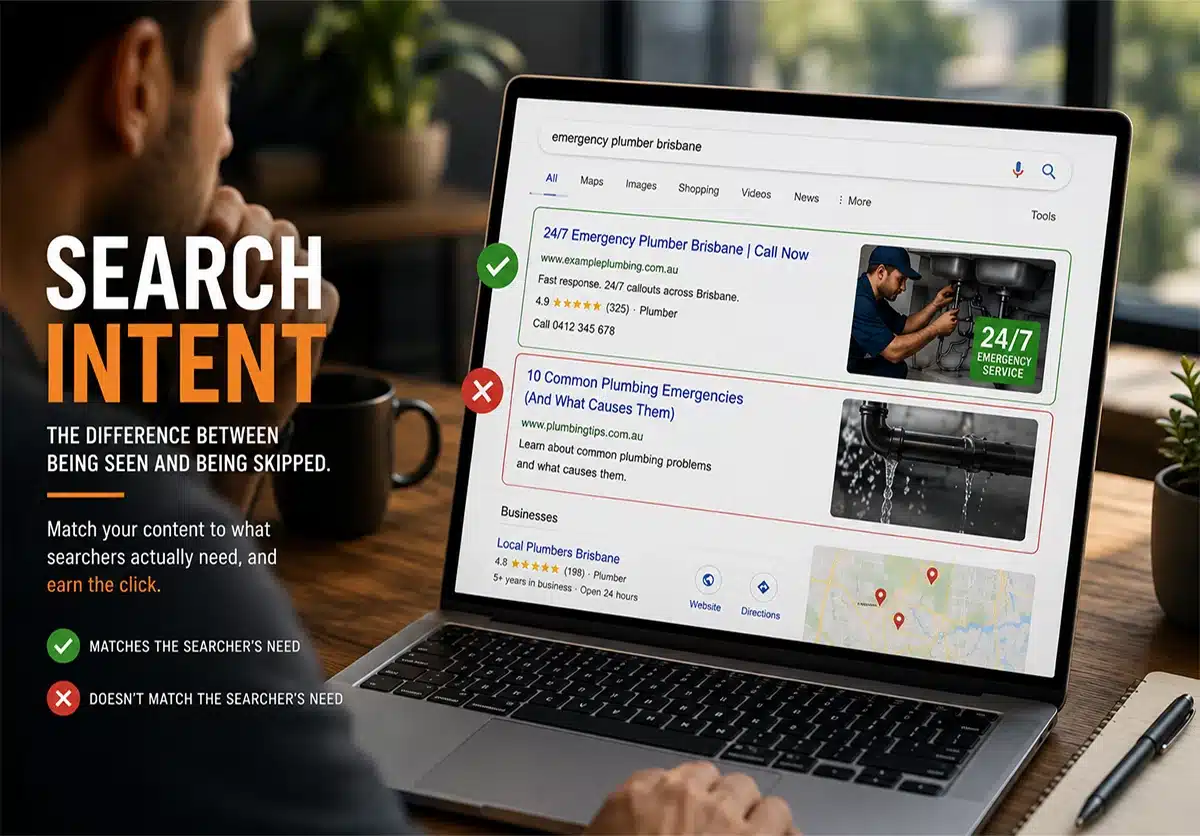
emergency plumber Brisbane
They probably want a plumber they can contact now.
They want to know whether you handle emergencies, whether you service Brisbane and how quickly they can reach you.
A result titled:
10 Common Plumbing Emergencies and What Causes Them
may be useful content.
It may even rank.
But it is probably not what that person needs at that moment.
Now change the search to:
what should I do if a pipe bursts?
That article suddenly makes much more sense.
Same industry. Similar subject. Completely different reason for searching.
That is search intent.
Searchers Are Looking for the Right Next Step
When someone looks at a page of search results, they are not only comparing rankings.
They are trying to work out which result is most likely to give them what they need next.
Sometimes they want an answer.
Sometimes they want a business.
Sometimes they want to compare several options.
Sometimes they already know the company they want and are simply trying to reach its website.
The search result needs to signal that the page matches that expectation.
If it does not, people move on.
This is why a page can have plenty of impressions but a disappointing click through rate. The result is being seen, but it may not feel relevant enough to earn consideration.
The Four Common Types of Search Intent
SEO tools normally group search intent into four broad categories.
They are useful, but you do not need to become obsessed with the labels.
The important part is understanding what the person expects to find.
Informational Intent
The person wants to learn or understand something.
For example:
why is my air conditioner leaking water?
They probably want an explanation before they want a sales pitch.
An article or guide makes sense.
Commercial Intent
The person is considering their options but has not necessarily decided who to choose.
For example:
best website designers Brisbane
They may compare agencies, services, experience, reviews and examples before contacting anyone.
Transactional Intent
The person is ready to take an action.
For example:
book carpet cleaning Brisbane
A service or booking page makes more sense than a long article about carpet cleaning techniques.
Navigational Intent
The person already knows where they want to go.
For example:
Scorched Media
They are probably trying to find the business itself rather than research website design generally.
Ahrefs groups search intent into informational, commercial, transactional and navigational categories. It also notes that some searches carry mixed intent rather than fitting neatly into one box. Read Ahrefs’ guide to keyword intent.
The Keyword Can Be Right and the Result Can Still Be Wrong
This is where businesses often get caught.
They choose a keyword because it looks relevant to the service.
Then they build a page around the words without thinking hard enough about what people searching those words actually want.
Imagine you want to rank for:
website redesign Brisbane
The words clearly relate to website redesign services.
But the person searching could be trying to:
- Find a company that redesigns websites
- Compare Brisbane website design agencies
- Understand how much a redesign costs
- Work out whether their existing website needs replacing
- See examples of redesigned websites
The keyword gives you a clue.
It does not always tell you the whole story.
This is why looking at the search results themselves is useful.
If Google is mainly showing service pages, that is a strong clue that people searching the phrase are looking for providers.
If the results are mostly guides and articles, the dominant intent may be informational.
If the page is full of comparisons and “best of” lists, people are probably still weighing their options.
Semrush recommends matching the content format to the search intent rather than relying on the keyword alone. Informational searches suit educational content. Transactional searches need a page where the person can act. Read Semrush’s guidance on matching content to search intent.
The Wrong Page Type Gets Skipped
You can write an excellent page and still have the wrong page for the search.
Someone searching for:
how much does carpet cleaning cost?
may respond well to an article explaining the factors that affect price.
Someone searching:
carpet cleaning Brisbane
is much more likely to want a service page.
And someone searching:
best carpet cleaners Brisbane
is probably comparing businesses.
Those three searches are closely related.
But the searcher is at a different point in each one.
Trying to make one page handle every possible intent usually makes the result less useful.
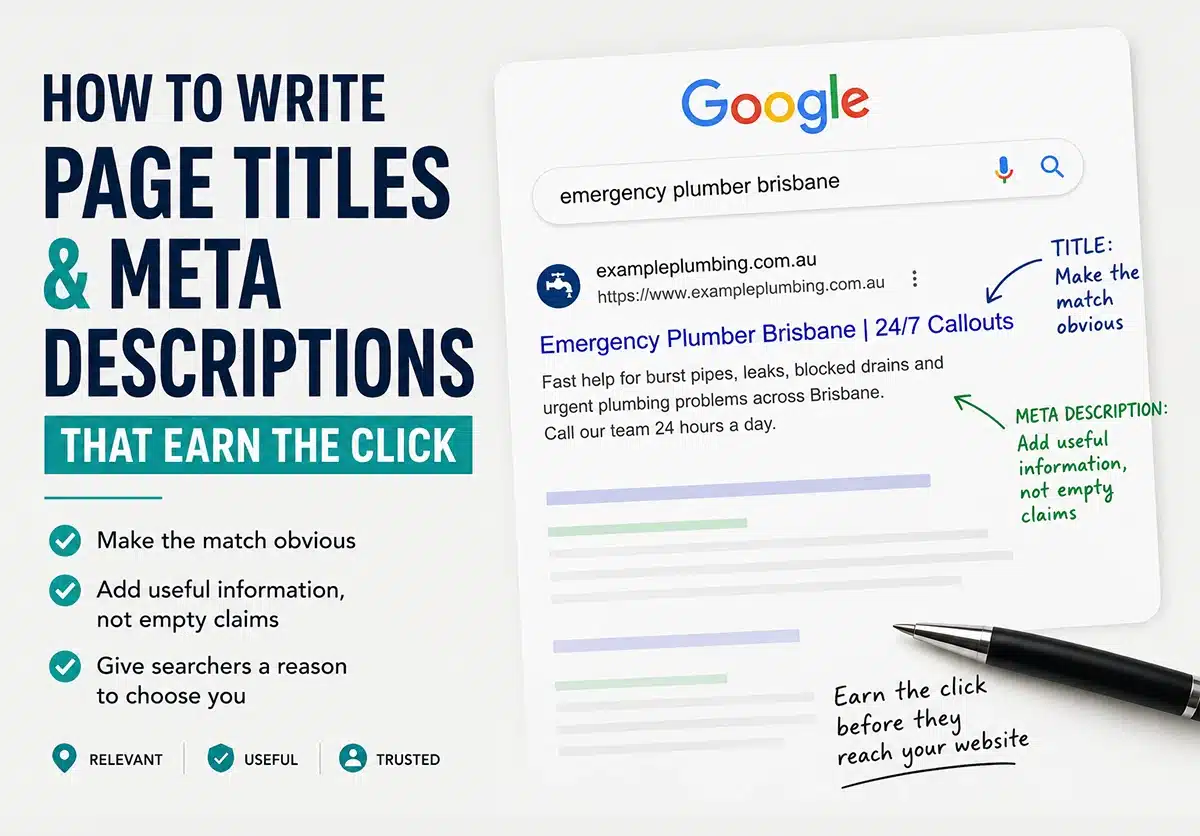
Your Title Needs to Signal the Right Intent
The searcher often decides whether the result matches before visiting the page.
Your page title is one of the first signals they see.
If someone searches:
emergency electrician Brisbane
a title such as:
Electrical Services Brisbane | Smith Electrical
is relevant.
But:
Emergency Electrician Brisbane | 24/7 Callouts
matches the immediate need much more closely.
The first result says the business provides electrical services.
The second says:
Yes. This is the service you are looking for right now.
The same applies to the description underneath it.
A good search result should help the person recognise that the page matches what they are trying to achieve.
We cover the practical side of that in How to Write Page Titles and Meta Descriptions That Earn the Click.
Relevance Is Not the Same as Ranking
This distinction matters.
A page can rank highly because Google considers it relevant to the query.
But the searcher still makes their own judgement.
They look at the wording, business, page type and other results around it.
A result sitting lower on the page can sometimes look like a much better fit for what they need.
That is why ranking position cannot tell you the whole story.
If a page has strong visibility but a weak click through rate, ask whether the result actually reflects the intent behind those searches.
The problem may not be that you need to rank higher.
The problem may be that the person does not see your result as the right next step.
Search Intent Can Change With Only a Few Words
Small changes to a search can reveal a big change in intent.
Compare:
solar panels
how do solar panels work
best solar panels Australia
solar panel installers Brisbane
solar installation quote Brisbane
They are all about solar panels.
But they are not asking for the same thing.
One person is learning.
Another is comparing.
Another is looking for local providers.
Another may be ready to request a quote.
This is why keyword research without intent can lead a business in the wrong direction.
A high-volume keyword is not automatically valuable if the people searching it are looking for something your page does not provide.
Local Searches Make Intent Even Clearer
For SMEs, local intent is particularly important.
Someone searching:
commercial cleaner Brisbane
is not usually looking for a history of commercial cleaning.
They are looking for businesses that provide the service in Brisbane.
The location itself tells you something about the expected result.
The page should make the service area obvious.
The title should look like a service result.
The content should help the person decide whether the business can help.
And the next step should be easy to find.
Search Intent Is Not Just About Google
The same principle applies when people search in newer ways.
Someone asking ChatGPT:
Who are the best website designers near me?
has a different need from someone asking:
What should I look for when choosing a website designer?
One is looking for businesses.
The other wants advice.
The technology delivering the answer has changed.
The reason behind the question has not.
This is why search intent remains useful even as search becomes more conversational.
The words may get longer and more natural.
The job is still to understand what the person is trying to achieve.
Do Not Build Pages for Search Engines Instead of People
Search intent becomes much easier to understand when you stop thinking only about keywords.
Ask:
If I typed this search myself, what would I genuinely want to see next?
That question often tells you more than a keyword score.
Google’s guidance says its systems are designed to prioritise helpful, reliable content created primarily to benefit people. It also asks whether someone will leave a page feeling they have learned enough to achieve their goal. Read Google’s guidance on people-first content.
That is very close to what search intent is trying to solve.
Did the person get what they came for?
How to Check the Intent Before Creating a Page
You do not need a complicated process.
Before building a page around an important search, check three things.
Look at the wording.
Words such as “how”, “why”, “best”, “compare”, “near me”, “price”, “book” and “quote” can provide useful clues.
Look at the current search results.
Are they service pages, articles, product pages, comparisons, maps or something else? Featured snippets, shopping results, a local pack or site links under a listing are also worth noting. Each one is a clue about what Google expects people to want.
Think about the customer.
What are they likely to need at that point?
An explanation?
A shortlist?
A service provider?
A price?
A phone number?
Then make sure the page you are asking them to click actually provides it.
Search Intent Is Part of Good SEO
Search intent is not an extra SEO trick.
It is part of making sure the right page appears for the right reason.
Good SEO should not only increase rankings and impressions.
It should connect relevant searches with pages that genuinely help the person making them.
That creates better traffic.
Not just more traffic.
The Bottom Line
Search intent is not really about memorising four SEO categories.
It is about understanding what the person needs at that moment.
Someone looking for an answer should see an answer.
Someone comparing options should see information that helps them compare.
Someone ready to contact a business should not have to fight through an educational article to find the phone number.
The keyword can be right and the page can still feel wrong.
That is when people skip the result.
Ranking gives you the opportunity to be considered.
Relevance decides whether you are.
Frequently Asked Questions
What is search intent?
Search intent is the reason behind a search. It is what the person is actually trying to find, understand, compare or do when they search.
What are the four main types of search intent?
The four commonly used categories are informational, commercial, transactional and navigational intent. They are useful guides, but some searches can have more than one intent.
Why does search intent matter for SEO?
A page is more useful when its content and format match what the searcher expects to find. The right keyword on the wrong type of page can still lead to weak click through rates, poor engagement or low-quality traffic.
How can I tell what the search intent is?
Look at the wording of the search and then check the current Google results. The types of pages Google shows can give you a strong indication of what people searching that phrase usually expect to find.
Can a keyword have more than one search intent?
Yes. Some searches have mixed intent. A person searching for a broad product or service may be learning, comparing and considering a purchase at the same time.