
Be Seen. Be Clicked. Be Chosen. The Complete Website Strategy
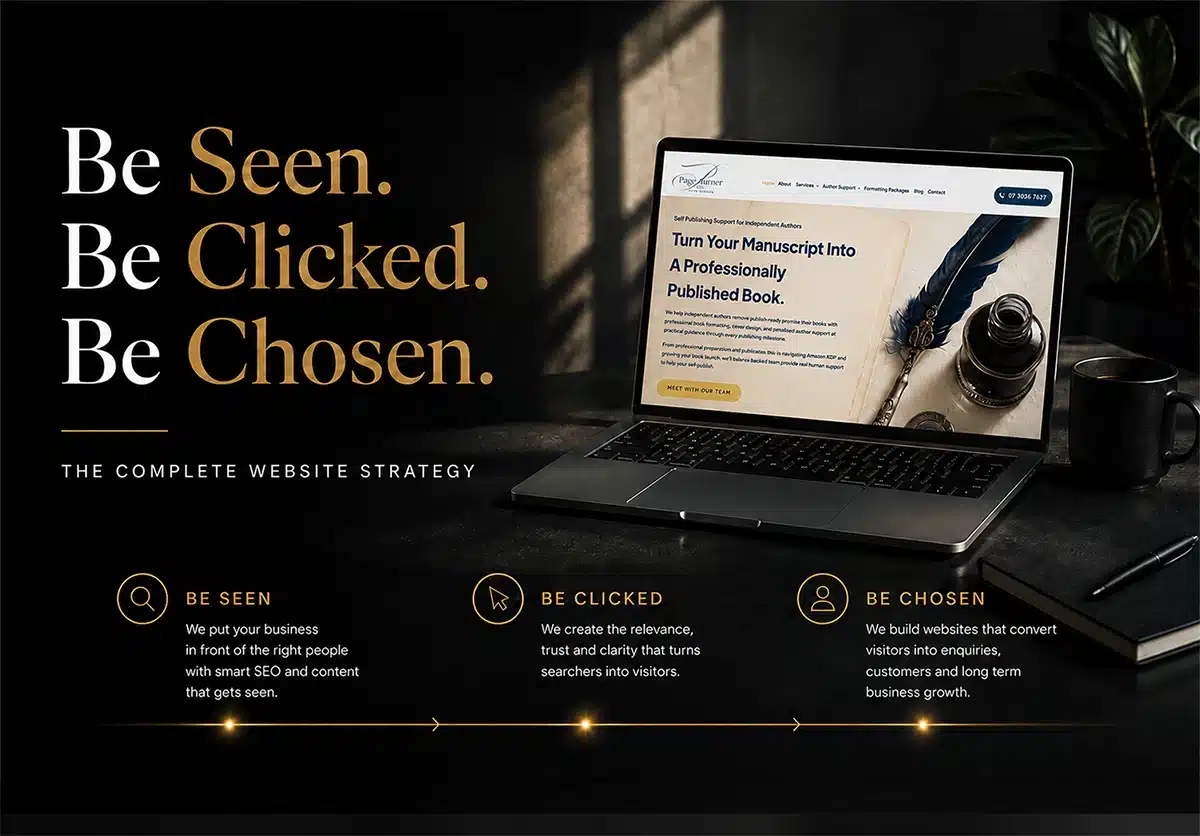
People finding your website is not the win. The win is when they choose you. When they call you or fire off an enquiry from your website.
Over the last 25 years, I’ve seen trends come and go, what works, what doesn’t, but the end goal has always remained the same. Engage the site visitor and have them contact you.
And that’s the point most businesses miss and it costs them more money than almost anything else. They chase rankings. They get them. The phone still doesn’t ring, and nobody can tell them why.
Here’s the why. A website strategy isn’t one job. It’s three parts working together to complete the customer journey.
Be Seen, Be Clicked and Be Chosen is the whole picture. What it actually takes to be seen. What makes someone click once they’ve found you. What makes them choose you once they land on your site. By the end you’ll know exactly which of the three is costing you the most enquiries right now, and what to fix first.
Every agency will sell you SEO, or a good-looking website, or copy rewrites, as if any one of those wins on its own. None of them do. Being seen, being clicked and being chosen are three separate areas, built by three different disciplines, and most businesses have only ever properly invested in one.
Usually the one that’s easiest to point at and measure, which is exactly why the other two go unnoticed. This is until someone asks why their competitor down the road who has a worse-looking website than they do is always fully booked.
So what does it take to Be Seen, Be Clicked and Be Chosen?
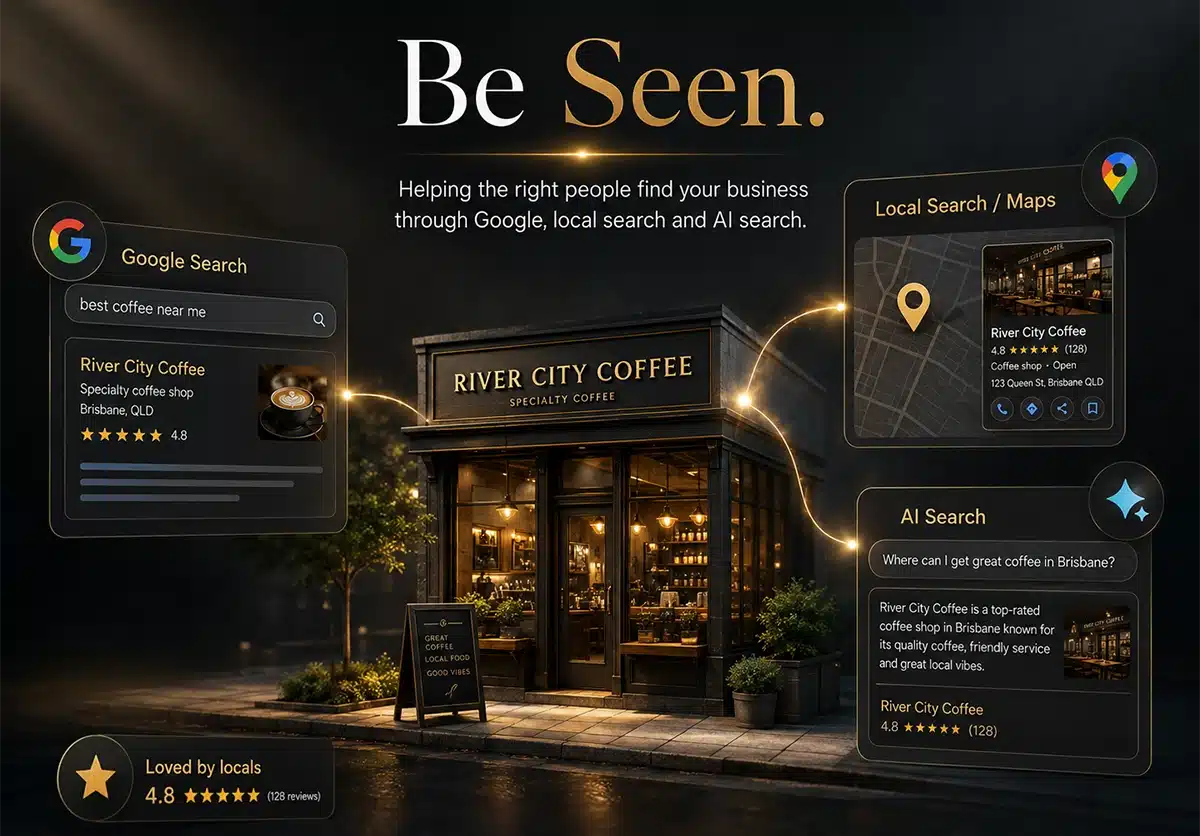
Be Seen
What Does Being Seen Actually Mean?
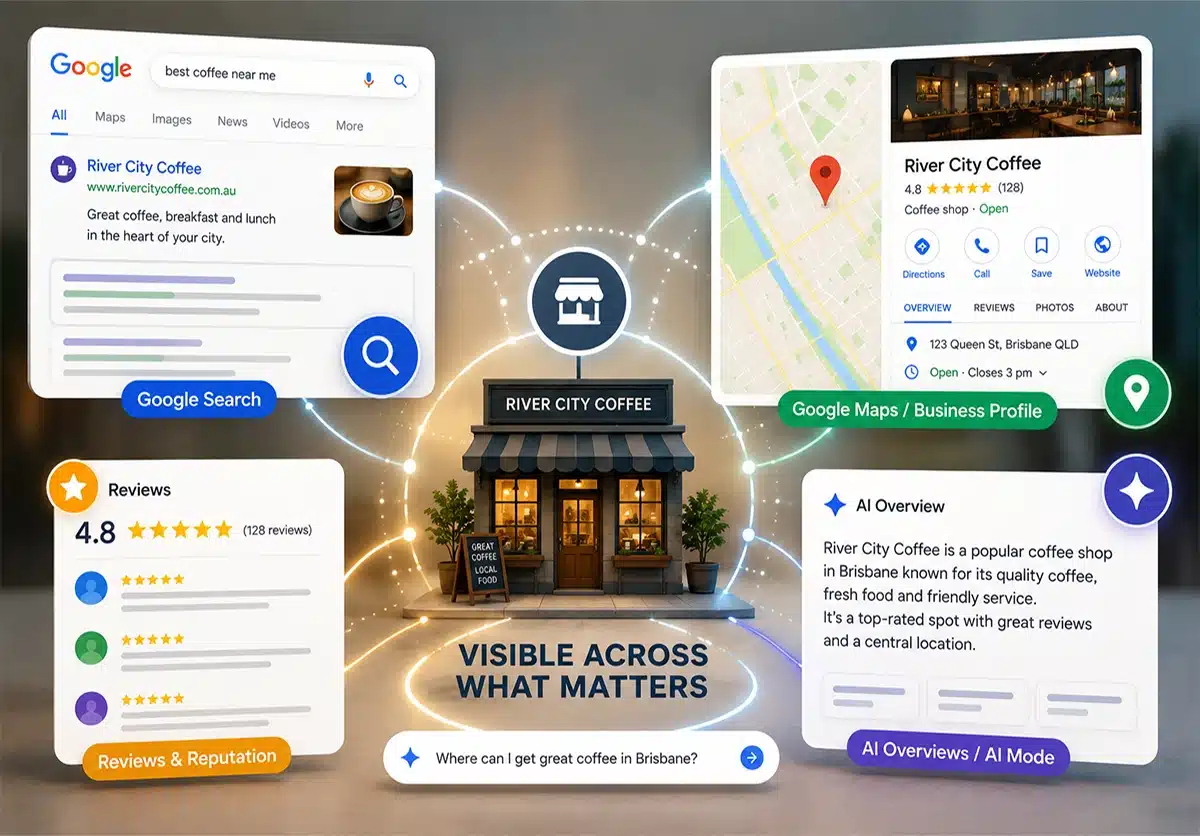
Being seen means your website shows up when someone searches the problem you solve, not just when they search your business name. That covers Google, Google Maps, your Business Profile, and now AI search results too. That’s the first job any website strategy has to do.
I’ve sat across from business owners who show me their page-one ranking like it’s the finish line. It isn’t one. Ranking for your own business name is the easiest search there is to win. Anyone typing it already knows who you are, already knows what you do, and was probably going to call you anyway. That ranking didn’t create a new customer. It just confirmed one who already existed.
The real test is different. It’s whether you show up when someone searches the problem you solve, with your name nowhere near the search. That’s the search a person actually types. Someone who has never heard of you, doesn’t know your business name, and is typing what’s wrong or what they need instead. If you’re invisible for that search, you’re invisible to every customer you haven’t met yet, and that’s most of them.
Brisbane makes this worse in a specific way. Plenty of local businesses compete against national franchises and directory sites with far bigger budgets, and the instinct is to try to out-shout them on the same generic terms. That’s a fight most local businesses can’t win, and don’t need to. A page built around the actual problem, written for someone in Brisbane rather than someone anywhere, competes on relevance instead of budget. That’s a fairer fight, and it’s one a local business can genuinely win.
This is where most businesses stop paying attention to their own website. They built pages around their services the way they’d describe them internally. “Residential Plumbing.” “Commercial Fitout.” “Bookkeeping Services.” That language makes sense in a company meeting. It’s not what a potential customer types into Google when they’ve got a burst pipe, a shopfront that needs work done by Friday, or a BAS due Monday they haven’t started. A page that only speaks in your own service categories will rank for your own name and almost nothing else, because it never answers the question the person is actually asking. Fixing that is part of any serious website strategy.
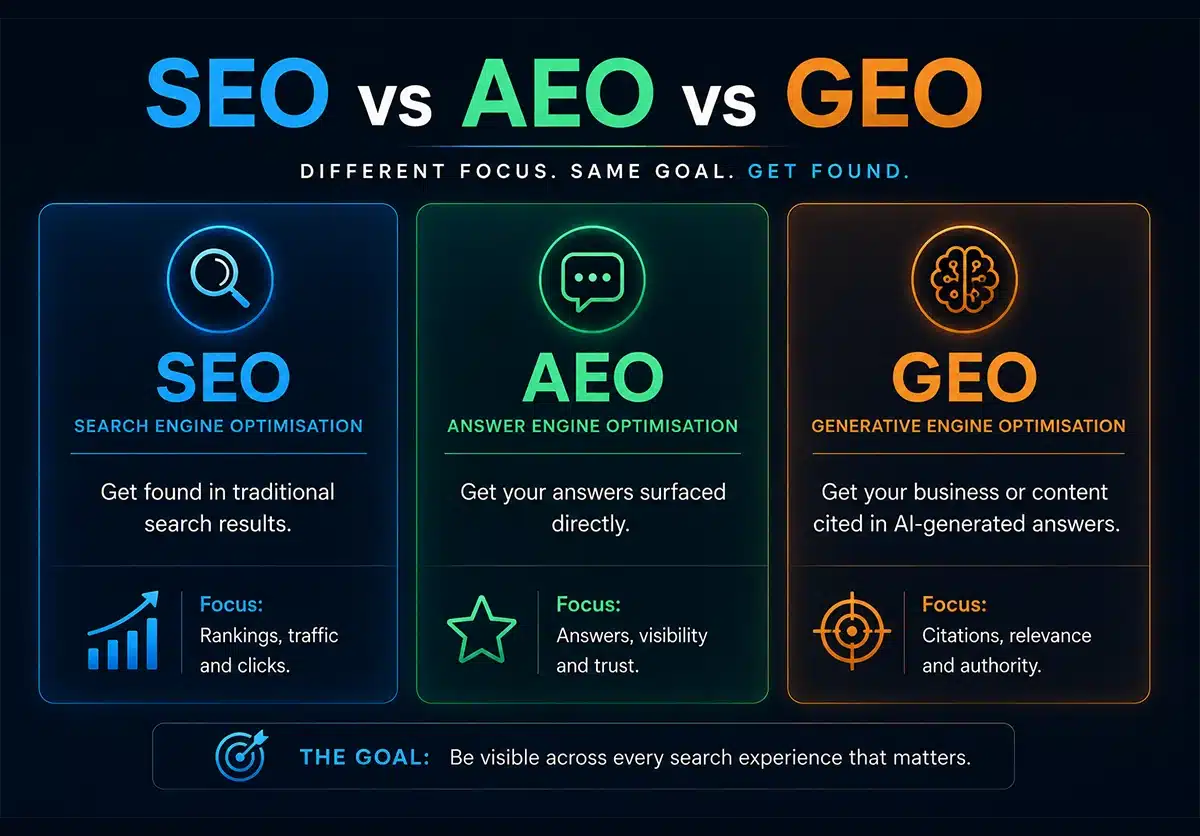
There’s a fourth surface now too, and almost nobody is checking it. AI search tools like Google’s AI Overviews are already answering commercial questions directly, often citing two or three businesses by name before the searcher ever sees a list of blue links. Being seen used to mean ranking. Now it also means being one of the few answers an AI system trusts enough to cite. Most business owners have never once checked whether that’s happening to them, or to their competitors instead.
Your Google Business Profile does a different job again, and most businesses treat it as a formality they filled in once and forgot. It’s often the first thing a nearby searcher sees, ahead of any website result. Google says local results are mainly based on relevance, distance and prominence, and things like accurate business information, the right categories and genuine reviews all help. A business with three reviews from two years ago is being outranked in the Map Pack by a newer competitor who simply asks every happy customer to leave one. That’s not a technical SEO problem. It’s neglect.
Try it right now. Search your business name. Then search what you actually do, with your business name left out entirely. If you disappear on the second search, you’re not being seen. You’re just easy to find by people who already knew where to look.
That gap, showing up for the problem instead of just the brand, is the visibility layer of a website strategy. We’ve written about the specific parts of it in more depth:
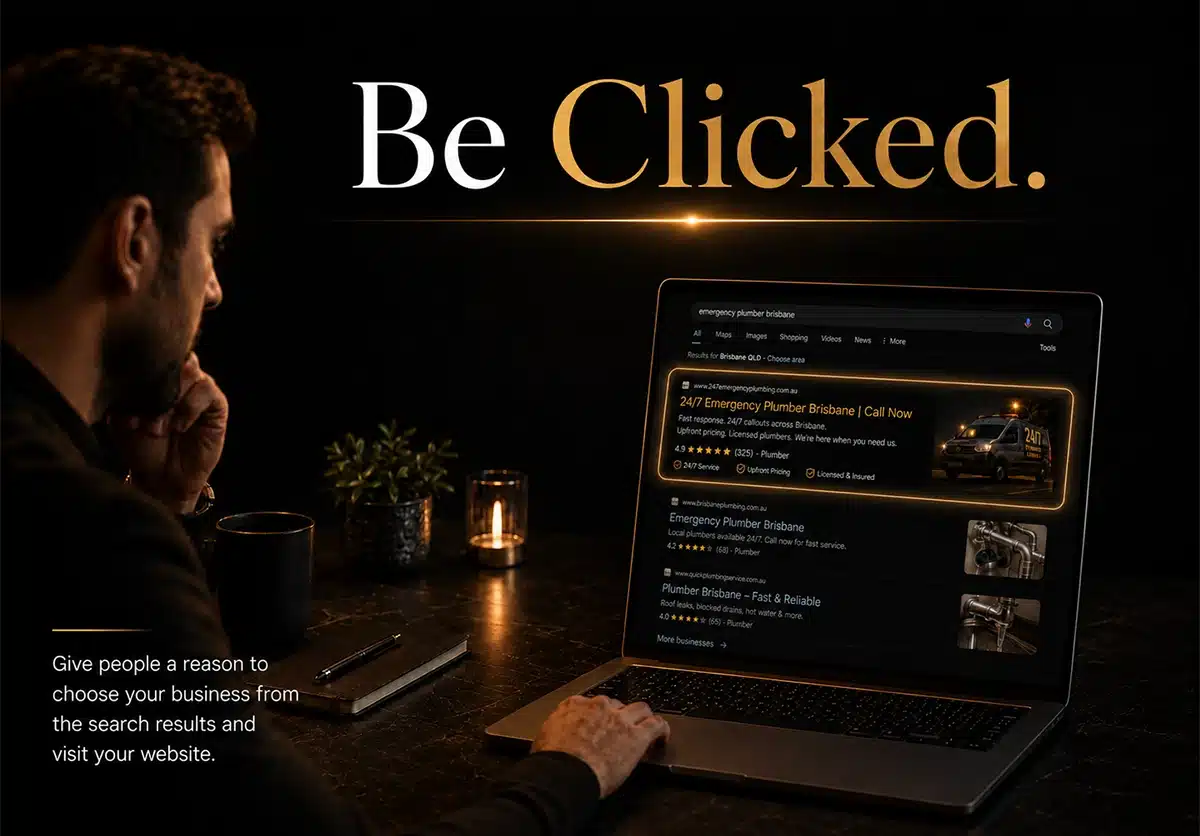
Be Clicked
What Actually Earns The Click, Not Just The Ranking?
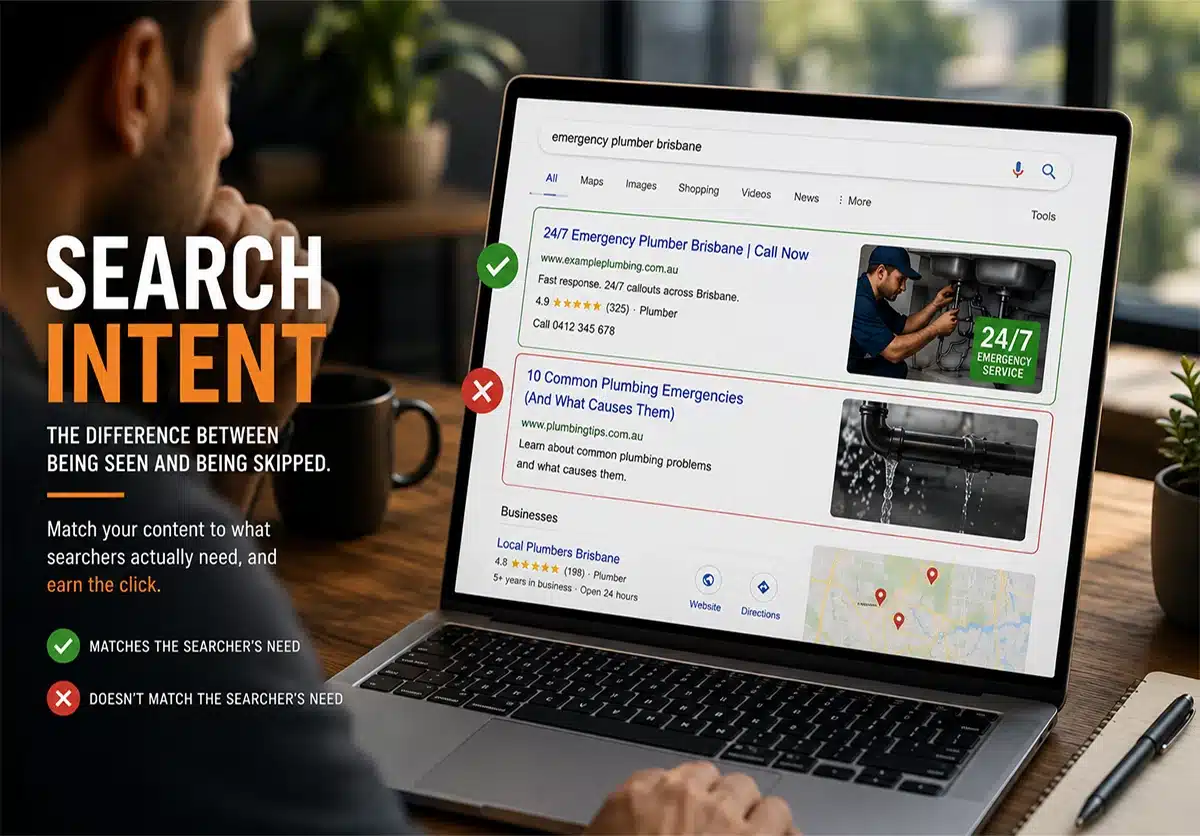
Earning the click means your listing gives someone a reason to pick you over every other result on the page. Ranking gets you onto the page. It doesn’t decide who clicks. That’s the second job in the website strategy, turning a ranking into a click.
Ranking and clicking are two completely different jobs, and most businesses only ever plan for the first one. Ranking is a technical, largely invisible signal. It’s Google deciding your page is relevant enough to show. Clicking is a human decision, made in under a second, while someone is scanning ten results that all claim to do roughly the same thing. Winning the first doesn’t win the second. I see Brisbane businesses rank well and still lose the click every day, because nobody ever wrote the listing to actually be chosen.
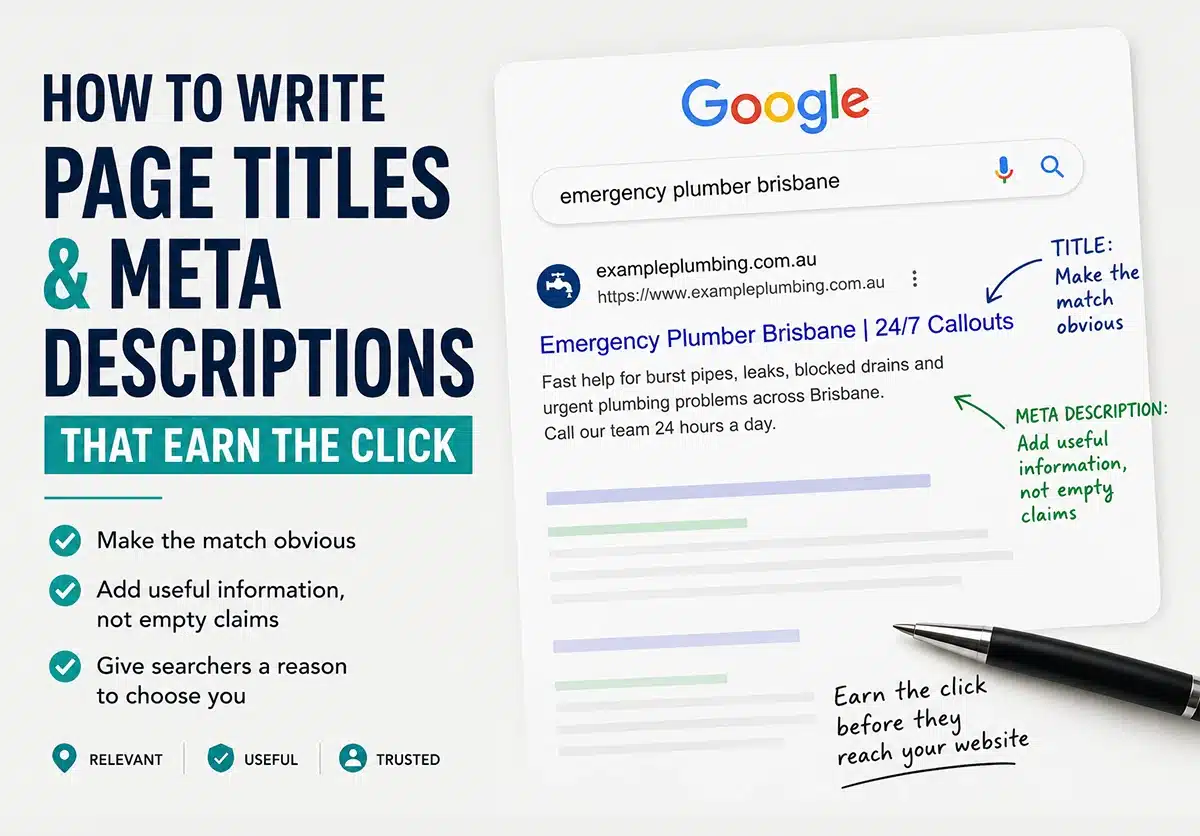
Here’s the issue I see a lot. “We rank on the first page, so we’re sorted.” In reality, Google decides exactly what it shows in the search result, but your title tag and meta description still drive the core listing it has to work with. AEO content (question and answer content) on the page plays a different role, helping your business surface in featured snippets, AI Overviews and cited answers. Many businesses let that pitch default to whatever their website platform auto-generates, which is usually the page title with the business name stapled on the end. That’s not a pitch. It’s a label.
Picture two listings for the same search. One reads “Home – ABC Plumbing Brisbane.” The other reads “Same-Day Blocked Drain Repairs Brisbane – Fixed Fast, No Callout Fee.” Both might rank in a similar position. Only one of them tells the person searching, in the two seconds they’ll spend reading it, exactly what they’ll get and why it solves the thing they typed. That’s the entire difference between being seen and being clicked.
There’s a second layer to this most businesses never touch. Search results increasingly show more than a blue link and two lines of text. Featured snippets, sitelinks, business information and AI-generated answers can all compete for the same few seconds of attention. Clear question-and-answer content on the page can also help your business get mentioned in featured snippets, cited in AI answers and included in AI Overviews. That means the content on the page can influence whether your business gets noticed before someone ever reaches the website.
People don’t click on business names. They click on the promise of a solution. Read your own Google listing like a potential customer scrolling past ten others. If your business name could be swapped out for a competitor’s and the listing would still make sense, that’s the problem. Nothing in it is telling the searcher why you’re the one to click. Every time someone skips your result for a competitor, that is a click you had the chance to win and didn’t. That’s a website strategy problem, not a ranking problem.
This is the copy and metadata layer of a website strategy. It’s the one many businesses skip entirely:

Be Chosen
What Makes Someone Choose You Once They’ve Landed?
Someone chooses you when your website answers, in seconds, who you are, what you do, and why you’re the better choice. That’s the job visibility and clicks can’t do on their own. It’s the third job of a website strategy, and the one most businesses skip.
In every keynote I give on this, I ask the room the same five questions. Every visitor asks these about a website in the first few seconds, whether they realise it or not. Who are you? What do you do? Can you solve my problem? Why should I trust you? What do I do next? Almost every business owner in the room can answer all five without thinking. Almost none of their websites do, because the business owner already knew the answers and didn’t notice that their website pages never actually said them out loud. They’ve never actually communicated it clearly to their potential customer.
And this matters more than most businesses think. Nobody actually reads your website content fully, especially within the first few seconds. They scan it. They’re looking for a headline that tells them who it’s for, a sentence or two that tells them what problem you solve, and something that tells them this business can help them, and is a strong choice for their needs. If those three things are buried below a generic photo and a vague tagline like “Quality Service You Can Trust,” the visitor has already half decided to leave, because that line could belong to any business in any industry. It says nothing specific about this one.
Too often, when I’m speaking to a potential client they start the brief with “We just need a nicer-looking website and people will book.”
Yes, an attractive web design will get someone to stay on your site for a few seconds longer. But, it doesn’t answer any of the five questions on its own. A beautifully designed page that never states who it’s for, what it actually does, or why to trust it will still lose the visitor to a plainer page that answers all three clearly. Clarity beats pretty every time trust is actually on the line, and trust is what’s on the line the entire time someone is deciding whether to pick up the phone. A website strategy built on looks alone will always lose to one built on clarity.
What good looks like is simple to describe and rare to see. A headline that names the exact problem or service, not a slogan. A line underneath it that states who it’s for, specifically enough that the right visitor recognises themselves. Some visible proof, Google reviews if you have them available, examples of your work if practical, a real number of years or jobs done, close enough to that headline that trust builds before doubt has time to set in. And one obvious next step, not five competing call to action buttons all shouting for attention.
Almost none of this forgiveness exists on a phone. Most of your traffic is arriving on a small screen, one thumb, one scroll, often with one eye on something else entirely. A page that technically answers all five questions somewhere in its copy still fails if the answer is three scrolls down, under a slow-loading image carousel. Mobile doesn’t just shrink the page. It shortens the patience. A website strategy that only works on desktop isn’t a complete one, and potentially costs you new business.
Try this on your own site, on your phone, right now. Give yourself five seconds. Can you answer all five questions in that time? Most owners can’t, on their own website, for the same reason they can’t see their own blind spots. They already know the answers, so their eye fills in what the page never actually says.
Why We Build Every Scorched Media Website To Do All Three
Too often, web designers will hand you a nice looking website, a sprinkling of SEO, and call the job done. That’s one job out of three, presented as the whole thing.
Being seen without being clicked just means you’re invisible in a more expensive way. You paid for the ranking and got nothing back from it. Being clicked without being chosen means you’re paying for traffic that leaves without calling, so every visitor becomes a cost with no return attached. I’ve watched businesses nail one of these three jobs, only to lose everything it earned to the other two.
That’s why Scorched Media doesn’t treat web design, content and SEO as three separate jobs that you build separately. Whether that’s a single provider who’s only ever really strong at one of the three, or an agency outsourcing pieces to people who never talk to each other, the result is the same. They need to be one connected website strategy. Otherwise, it’s not really a strategy at all and that leads to extra expense and missed opportunities for your business.
When we build a website, we start with the structure that helps you get seen, develop the content that earns the click, and set the page up to build trust fast enough to convert. All three are decided together from the start, not bolted on in whatever order the budget allows. Every website we build has to do all three jobs. Doing two well and ignoring the third gets you exactly what most businesses already have. Traffic that doesn’t turn into calls.
If you’re ranking but not getting enquiries, or getting traffic that goes nowhere once it lands, the question isn’t which part to fix first. It’s where, specifically, you’re losing the customer, because that’s the only question that actually points to an answer.
This is the difference between a website and a strategy. A website is a thing you own. A strategy is something built to do a job, checked against whether it’s actually doing it. Most of the businesses I’ve worked with over 25 years didn’t need a full rebuild. They needed someone to point at the exact place in the journey where a visible, clickable business was quietly losing people it had already worked hard to earn.
Not sure where your website is losing enquiries? Book a free 15-minute strategy review.
Frequently Asked Questions
What is a website strategy?
A website strategy connects visibility, the click and trust into one journey, so your website gets seen, earns the click, and turns visitors into enquiries. Most website strategies only ever cover one or two of those three jobs.
Why does my website rank well but still not get enquiries?
Ranking measures visibility, not persuasion. A page can rank well and still lose the visitor. That happens when the listing doesn’t earn the click, or the page doesn’t answer who you are, what you do, and why to trust you, fast enough. This is exactly why a website strategy has to cover more than SEO.
What’s the difference between being seen and being chosen?
Being seen means people can find you in search. Being chosen means they pick you once they land on your site. You can be highly visible and still lose the customer at the choosing stage if your website doesn’t build trust quickly. That’s the piece most website strategies miss.
How long do I have to convince a website visitor?
A matter of seconds. Visitors decide whether they’re in the right place almost immediately. That decision comes down to whether your website answers who you are, what you do, and what to do next.
Does Scorched Media help with all three stages?
Yes. Being seen, clicked and chosen isn’t three separate services to us. It’s one connected website strategy, and we build every website to do all three.