
How to Increase Website Visibility
You might be showing up in Google thousands of times a month and still not getting enquiries. That is not a rankings problem. It is a website visibility problem, and the two are not the same thing.
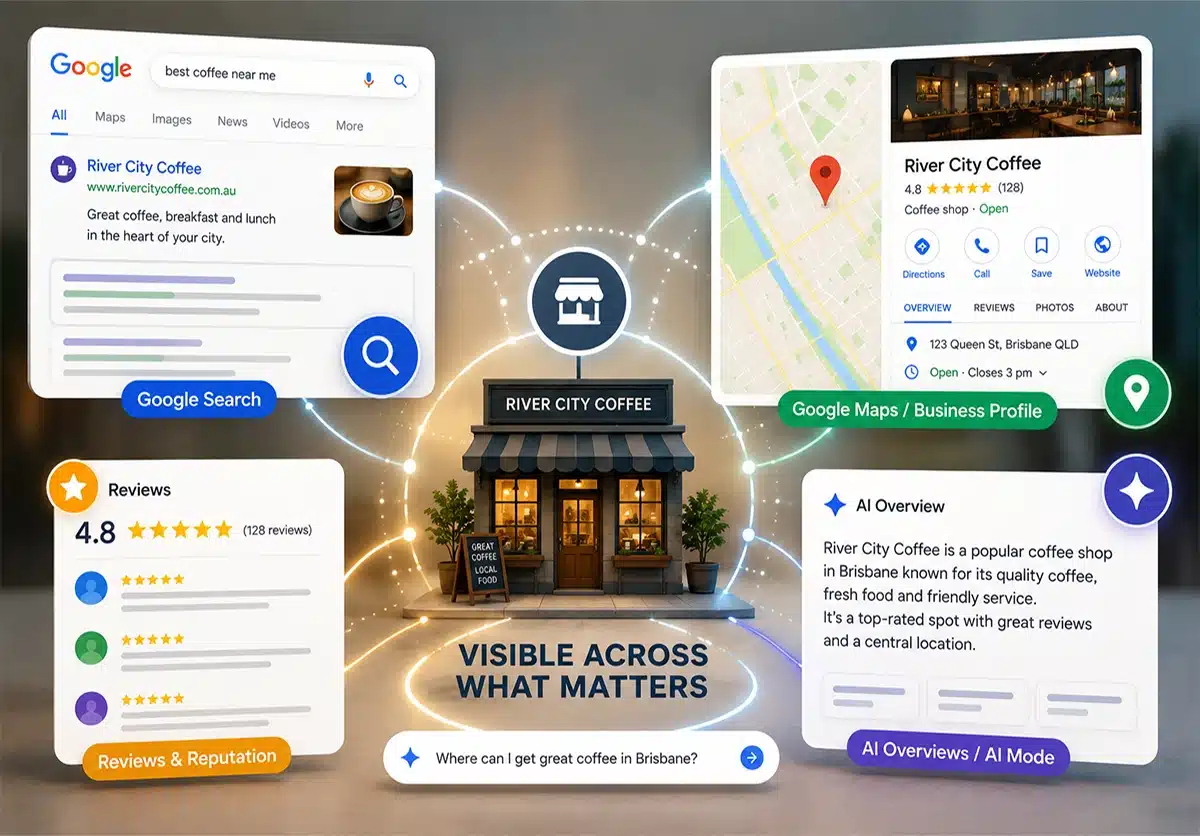
For years, increasing website visibility meant one thing: rank higher in Google. That still matters, but it is no longer the whole picture. People find businesses through Google Maps, local search, AI Overviews, AI Mode, and tools like ChatGPT and Gemini, often before they ever land on a website. You might be seen in a review, a listing, or an AI answer long before anyone clicks through to you.
So the real question is not just where do you rank. It is where can the right person actually find you, and does what they find make them want to act.
What Website Visibility Actually Means
Website visibility, sometimes called search visibility, is how often and how prominently your business shows up when people search for what you offer. A few years ago you could judge this by checking your position for a handful of keywords. That test is too narrow now.
A search result today can include organic listings, Google Maps, Business Profiles, AI Overviews, images, videos, reviews, local results and related questions. People are also asking AI tools to research problems and compare options before they ever type into Google.
That changes the question you should be asking. Not “where do we rank.” Instead: where can someone looking for what you do actually discover you? Rankings still matter, but they are one piece of a much bigger picture.
More Website Visibility Does Not Always Mean More Business
It is tempting to treat more impressions, more rankings and more traffic as automatically good. They are not.
You might appear 20,000 times a month for searches that have almost nothing to do with what you actually offer. The report looks impressive. It creates almost no commercial value. Meanwhile another business appears only 2,000 times, but every one of those searches comes from someone actively looking for exactly what they sell. That smaller number is worth more.
Visibility needs context. What matters is showing up for searches connected to the services you provide, the problems you solve, the questions your customers actually ask, the locations you serve and where they are in the buying process.
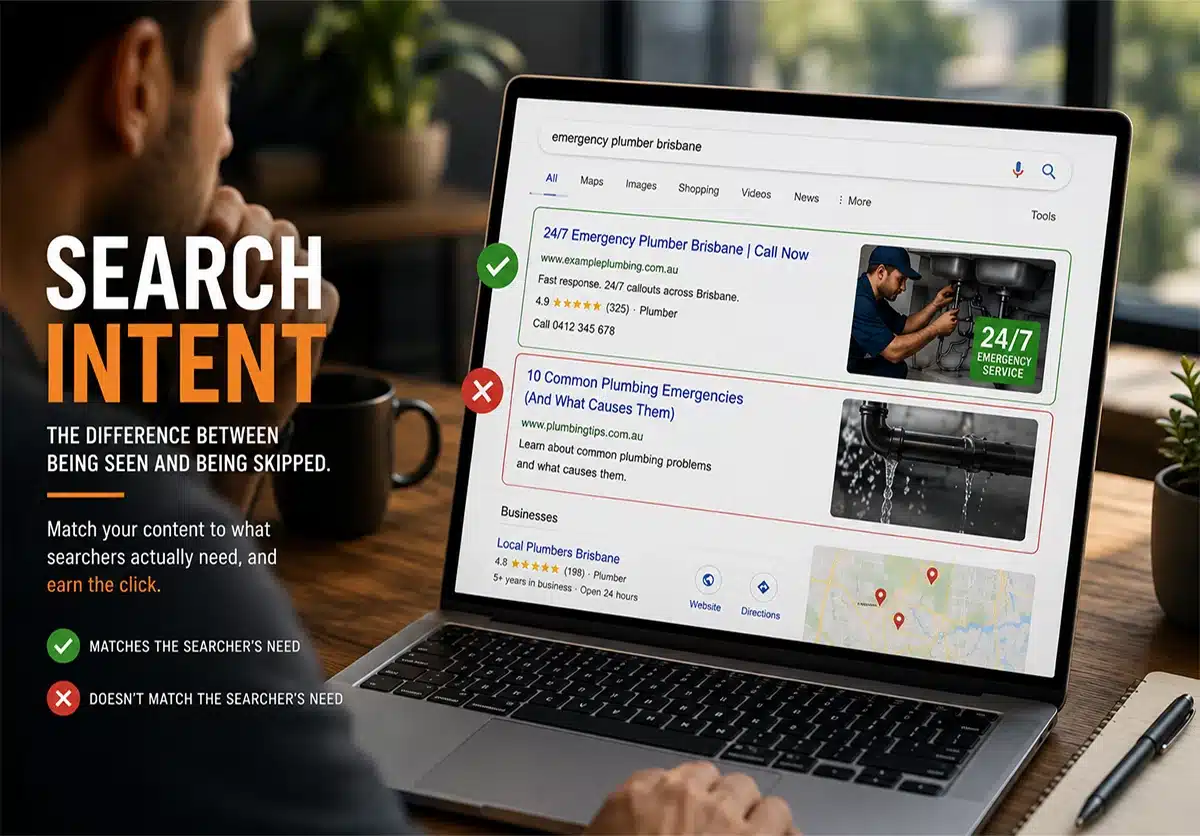
Strong SEO increases the odds of the right person finding the right page. Traffic comes later. Being found is not the win. Being chosen is.
Search Engines Need to Understand What You Actually Do
If your website does not clearly explain your business, visibility gets harder, no matter how much content you publish.
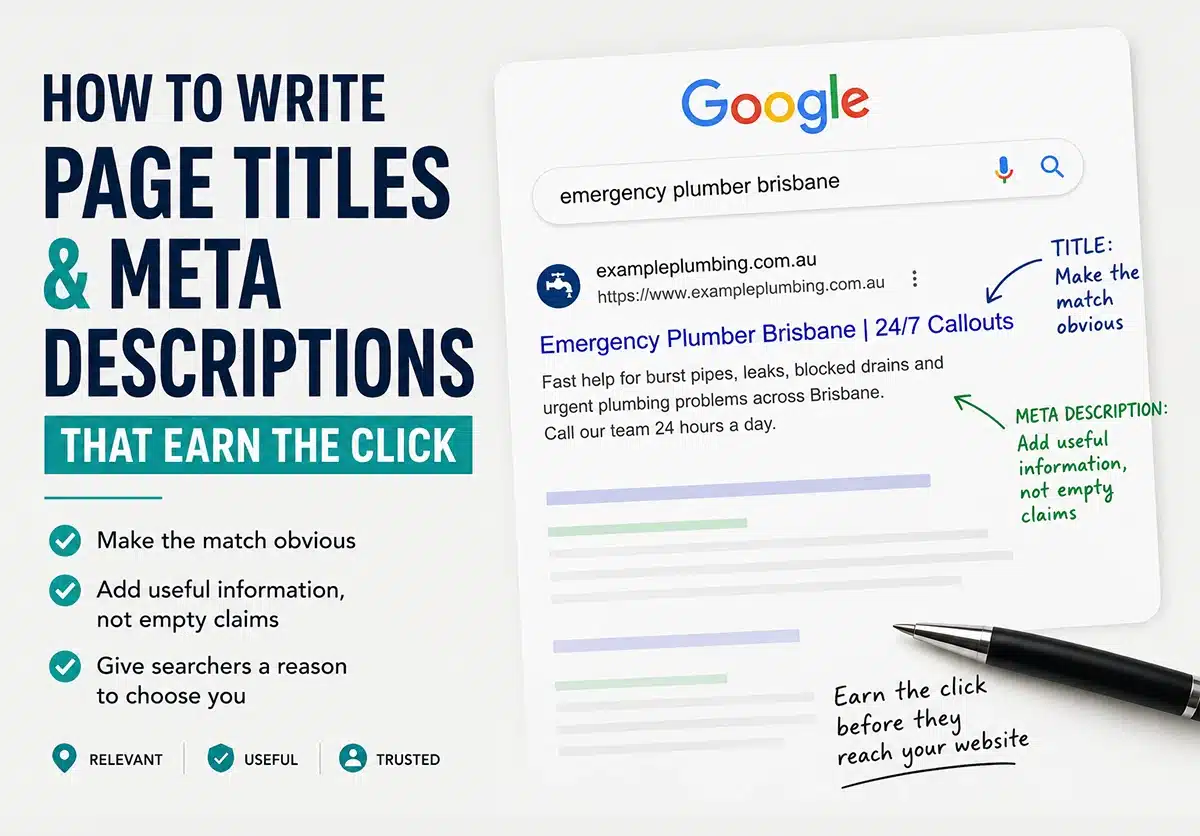
This shows up in familiar ways. Several services squeezed onto one page. Industry jargon that customers do not actually search for. Broad statements that could describe almost any company. “We provide innovative solutions tailored to your needs” might sound polished, but it tells a search engine, and a customer, almost nothing.
Your important services need enough space to stand on their own. A visitor, and a search engine, should be able to tell what you provide, who it is for, what problem it solves, where you provide it, and how your services connect. That does not mean a page for every keyword variation. It means giving the topics that matter real depth.
Structure carries weight too. Clear service pages, useful hub pages and sensible internal links show how your topics relate to each other, and make it easier for someone to actually move through your site. A website that makes sense to a visitor usually makes sense to a search engine as well.
Useful Content Gives People More Ways to Find You
A homepage and a handful of service pages only give you so many chances to appear in search. Useful supporting content creates more, but only if you publish it for the right reason.
The strongest ideas usually come from questions your customers already ask you. What do people want to understand before they get in touch? What comes up again and again? What mistakes do they make? What do you find yourself explaining on every sales call? Those conversations are the content you are missing.
A service page explains what you offer. A supporting article can go deeper on one specific problem, and that gives someone another way to find you, often earlier than you would expect. They might not be searching for a provider yet. They are still trying to understand the problem. If you are the one who explains it clearly, they have already found you, even if they never search your business name.
This is where real experience shows. Generic content explains what something is. You can explain what actually goes wrong, what your customers should be weighing up, and what really happens once the work starts. Google’s own guidance continues to say useful, original content matters across both traditional search and newer AI search experiences.
Local Visibility Plays by Different Rules
If you serve a local market, your website visibility stretches well past a standard organic result. Someone searching for your service in Brisbane might see Google Maps, Business Profiles, reviews and local listings before they see a normal website result at all. In these searches, your business itself becomes part of what shows up.
That means local visibility depends on more than your website. Google says its local results are mainly influenced by relevance, distance and popularity. Complete business information, reviews and links all play a part.
Someone might find you through Google Maps, your Business Profile, a customer review, a local service page, a standard Google result, or a local article or directory. The strongest local visibility happens when all of these agree with each other: the services are clear, the details are accurate, the location makes sense, the reviews back it up, and the website confirms what you do and where you operate. That is a far stronger position than repeating your suburb’s name down the page.
Your Reputation Lives Beyond Your Own Website
Search visibility is also shaped by what exists about your business elsewhere online. Reviews, directories, industry organisations, news coverage and other reputable sites all help establish who you are and whether you look credible. This has always mattered through links and authority. It matters even more now that search platforms are trying to piece together who a business actually is from many different sources at once.
Saying you are experienced and trusted on your own website is one thing. Having other sources back that up is another.
Useful signals here include genuine customer reviews, professional associations, reputable listings, local references, industry mentions, media coverage, links from relevant sites, and consistent business details across all of them. This is not about chasing hundreds of links or submitting your business to every directory going. One legitimate mention from a trusted industry body or local publication does more than a pile of low quality links built purely for SEO. Real website visibility partly comes down to being easy to recognise and verify.
AI Search Has Widened Where You Can Be Found
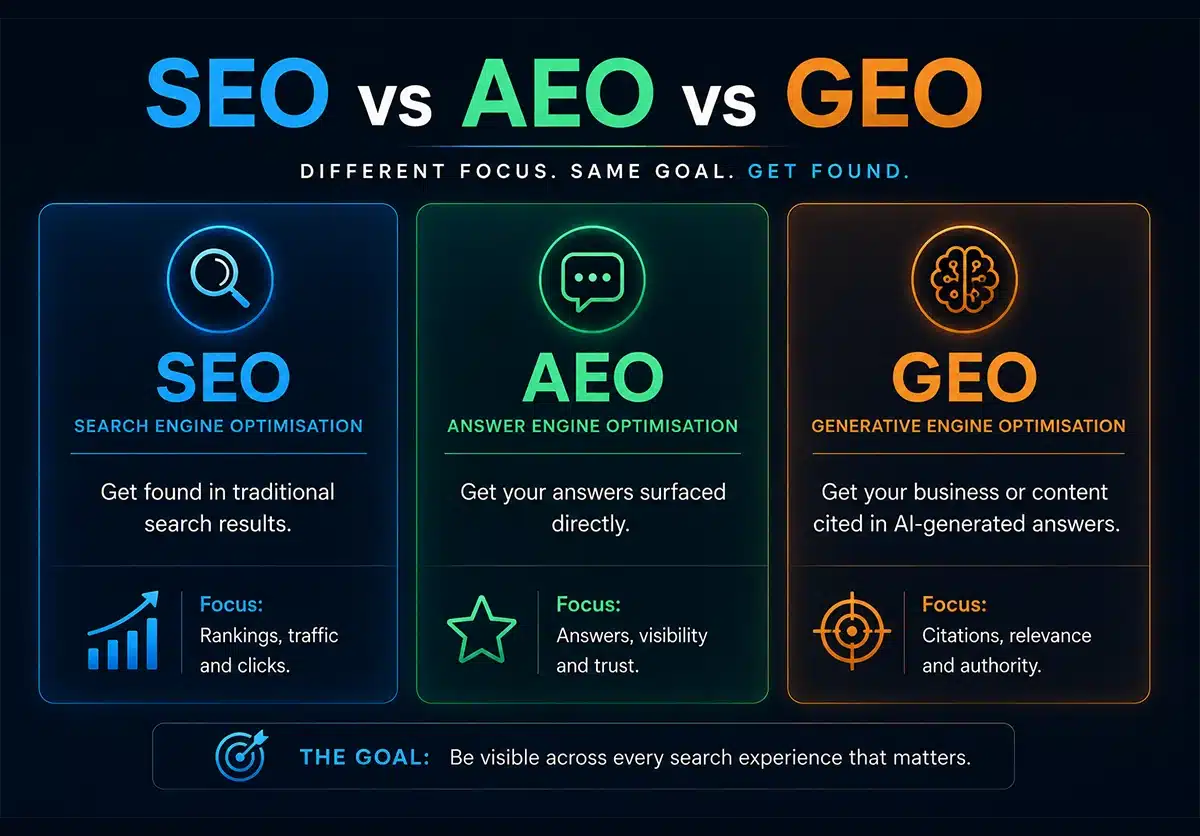
AI search is one of the biggest shifts in website visibility in recent years. Google AI Overviews and AI Mode answer questions directly inside Google. People also ask ChatGPT and Gemini to research services, compare options and answer questions outright. That has brought a wave of new terminology with it: AEO, GEO, AI SEO, LLM optimisation.
For you, the practical issue is simpler than the acronyms suggest. Search systems still need information they can understand and trust. Google’s own guidance says established SEO practices remain relevant to its generative AI search features. The fundamentals still carry the weight: explain clearly what you do, answer real questions, keep your information original, show genuine experience, keep your business details accurate, build a website that makes sense, and maintain a credible presence beyond it.
None of that is a one-off task. Website Visibility work is not something you finish. What ranks well today can slip if it is not kept current.
AI search changes where information shows up. It does not remove the need to create information worth finding in the first place. Be careful about chasing every new AI tactic while your service pages stay thin, your content stays vague, or your site stays badly structured underneath it all.
Technical Problems Can Still Quietly Cost You Visibility
Technical SEO supports website visibility, but it should not run the show. The real question is simple: is anything on your website making your useful pages harder to find?
Check the basics. Pages should work properly on mobile. Important links should not be broken. Old URLs should redirect correctly when pages move. Useful pages should not be accidentally blocked from search. Your site should be secure and reasonably fast, and navigation should make your best content easy to reach. Technical problems can stop good content from performing, but fixing them will not save a page that has little useful information to offer in the first place. Both need to work together.
Measure Visibility Beyond a Single Keyword
Businesses often judge SEO by watching where they rank for a handful of searches. That is useful, but narrow. Google Search Console gives you a much broader picture: how often your pages appear, which searches trigger them, which pages get seen, how your average position moves, which searches actually generate clicks, and how all of that shifts over time.
Impressions matter here more than people think. Google defines an impression as an instance where someone saw, or potentially saw, a link to your website in a search result. The number on its own does not tell you much. The real questions are whether your important service pages are appearing more often, whether relevant searches are increasing, whether local searches are improving, whether your articles are creating new entry points, and whether your site is becoming visible across a wider range of relevant topics. That tells you far more than watching one keyword inch up or down.
Real Visibility Never Sits in One Place
Visibility is becoming more spread out. You might be discovered through your website, Google Maps, an AI answer, a review, an article, or a mention somewhere else entirely. That means your presence should not hang on one keyword, one ranking or one platform.
A business with strong visibility usually has several things working together: clear services, findable content, an established local presence, a reputation backed up outside its own website, pages that actually work, and business information that is consistent everywhere it appears. Search platforms need to be able to piece together what you do and when you are relevant. The surfaces will keep changing. The need to be easy to find will not.
If you are not sure how visible your business really is, a Scorched Media site audit gives you a clear picture: not just where you rank, but where you are found and what to fix first. Book your free 15-minute site audit today.
Frequently Asked Questions
Is search visibility the same as website visibility?
Yes. Search visibility is another name for website visibility. Both describe how often and how prominently your business shows up when people search for what you offer.
What is website visibility?
It’s how often and how prominently your business shows up when people search for what you offer, across Google results, Maps, AI Overviews and everywhere else people look.
What’s the difference between visibility and rankings?
Rankings are one page, one keyword. Visibility is how often you show up across every search, tool and platform that matters to your business.
How do I check my website’s visibility?
Start with Google Search Console. It shows how often your pages appear, which searches trigger them, and how your position changes over time.
Does AI search change website visibility?
Yes. Tools like AI Overviews, AI Mode, ChatGPT and Gemini are changing where people find businesses. Useful content and a credible online presence still matter most.